AI in Education: A Helpful Tool or a Shortcut to Lazy Thinking?
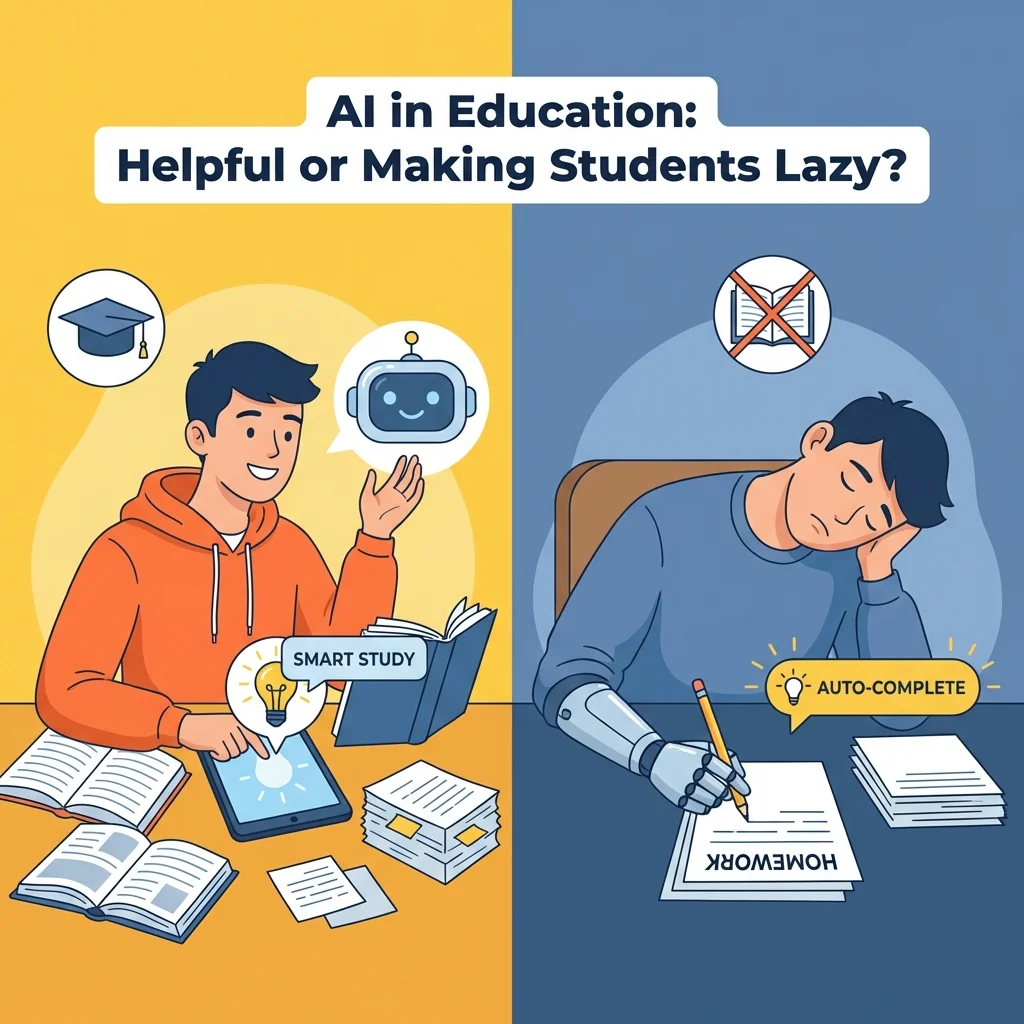
The massive rise of Artificial Intelligence (AI), like ChatGPT, Claude, and Gemini, has sparked a huge debate in education. This isn’t just a passing trend—it’s completely changing how we learn, research, and create.
The big question isn’t “Should we use AI?” anymore. It is: Does AI act as a support that helps us learn faster, or does it become a crutch that makes us stop thinking for ourselves?
This article breaks down the issue simply, looking at real data and how our brains actually learn.
1. Is Everyone Really Using AI? (The Reality)
Before we talk about the good and the bad, let’s look at the numbers. Is AI really taking over?
Usage Statistics (2024-2025)
According to a recent survey by the Walton Family Foundation:
- 63% of students admit to using AI chatbots at least once a week for schoolwork.
- 72% of teachers now agree that AI is a tool to be learned, not feared—a big change from just a year ago.
- 40% of students at top universities use AI to brainstorm essay ideas or simplify growing reading lists.
This shows that schools are no longer fighting AI. The conversation has shifted from “banning it” to “using it the right way.”
2. The Good News: AI as a Personal Tutor
One of the strongest arguments for AI is its potential to solve a classic problem: Personalized Learning.
Decades ago, research found that students who had one-on-one tutors performed much better than students in regular classrooms. Why? Because a personal tutor can explain things at your pace and answer your specific questions. But, paying for a tutor for every single student is too expensive for most schools.
AI as the “Infinite Tutor”
This is where AI steps in. Recent studies from Harvard and Stanford show that AI can act like a personal tutor in two key ways:
- Instant Feedback: In a normal class, you might wait days to get your homework graded. With AI, you get feedback in seconds. Learning happens best when you correct a mistake right after you make it.
- Custom Explanations: If you don’t understand Calculus, AI doesn’t just repeat the textbook. It can back up and explain the Algebra basics you missed, or explain physics using soccer analogies if that helps you understand better. It meets you exactly where you are.
Supporting Data: A study at Khan Academy (2023) showed that using their AI assistant (Khanmigo) increased student engagement in math by 30%. Students stayed interested longer because they weren’t getting stuck and frustrated.
3. The Risk: Losing Our Mental Muscle
On the flip side, the worry that AI will make us “lazy” is very real. Scientists call this Cognitive Offloading. Basically, our brains like to save energy. If there’s an easier way to get an answer, our brain will take it.
A. The “Google Effect” on Steroids
Years ago, improved internet search engines led to the “Google Effect”—people stopped remembering facts because they knew they could just search for them. We became experts at finding answers, not knowing them.
With AI, the risk is higher. Google gave us links to read; AI gives us the final answer.
- The Impact: We might lose the ability to connect the dots ourselves. If AI always summarizes the reading for us, we never practice the skill of summarizing complex information on our own.
B. Believing the Machine Too Much
AI sounds very confident. It writes perfect sentences. But sometimes, it makes things up (hallucinations).
- The Danger: If students don’t have a strong foundation of knowledge in their heads, they can’t tell when the AI is wrong. They might believe a fake historical fact just because the AI laid it out convincingly. This is the “Illusion of Competence”—feeling smart because the AI is smart.
C. Formatting Thoughts (Writing)
Writing isn’t just typing words; writing is thinking. When we struggle to write an essay, we are struggling to organize our thoughts and logic. If we let AI write the first draft, we skip that mental workout. It’s like sending a robot to the gym for you; the robot gets stronger, but you don’t.
4. Changing How We Grade: The Death of the Essay?
Because AI can write a standard history essay in 5 seconds, teachers have to change how they grade. Simple homework assignments like “Summarize Chapter 5” or “Write 500 words on WWII” are becoming obsolete.
So, what do we do? We “Level Up”:
- Critical Evaluation: Instead of writing an essay from scratch, a teacher might give students an essay written by AI and say: “Find 3 mistakes in this AI essay and explain why they are wrong using your textbook.”
- Creation & Context: Assignments will ask for things AI can’t easily fake—like connecting a history lesson to a personal experience the student had last week, or interviewing a local community member.
5. How to Use AI Without Getting “Dumb”
Instead of banning AI (which doesn’t work), experts suggest we should focus on AI Literacy. Here is what students need to know:
- It’s a Prediction Machine, Not a Truth Machine: Understand that AI is basically guessing the next word based on patterns. It doesn’t “know” facts like a human does.
- Ethics: Talk about bias, privacy, and how relying on automation changes society.
- The Pilot, Not the Passenger: Learn to be the pilot. Use AI to brainstorm, to check your grammar, or to explain a tough concept—but never let it do the thinking for you.
Conclusion: Partner, Not Replacement
Will AI make us stupid? The answer depends on you.
- If you use AI to replace your thinking (like getting it to write your whole paper), then yes, your skills will shrink.
- If you use AI to extend your thinking (like a sparring partner to debate ideas with), you can become smarter and more capable than ever before.
The future isn’t “Humans vs. AI.” It’s “Humans who work with AI vs. Humans who refuse to learn.”
As Steve Jobs once said:
“Technology is nothing. What’s important is that you have a faith in people, that they’re basically good and smart, and if you give them tools, they’ll do wonderful things with them.”
References & Further Reading:
- Bloom, B. S. (1984). The 2 Sigma Problem: The Search for Methods of Group Instruction as Effective as One-to-One Tutoring.
- Sparrow, B. (2011). Google Effects on Memory: Cognitive Consequences of Having Information at Our Fingertips.
- Mollick, E. (2023). Co-Intelligence: Living and Working with AI.
- Walton Family Foundation (2024). Impact of AI on Education Survey.
Author
Author