AI in Art: The End of Creativity or a New Renaissance?
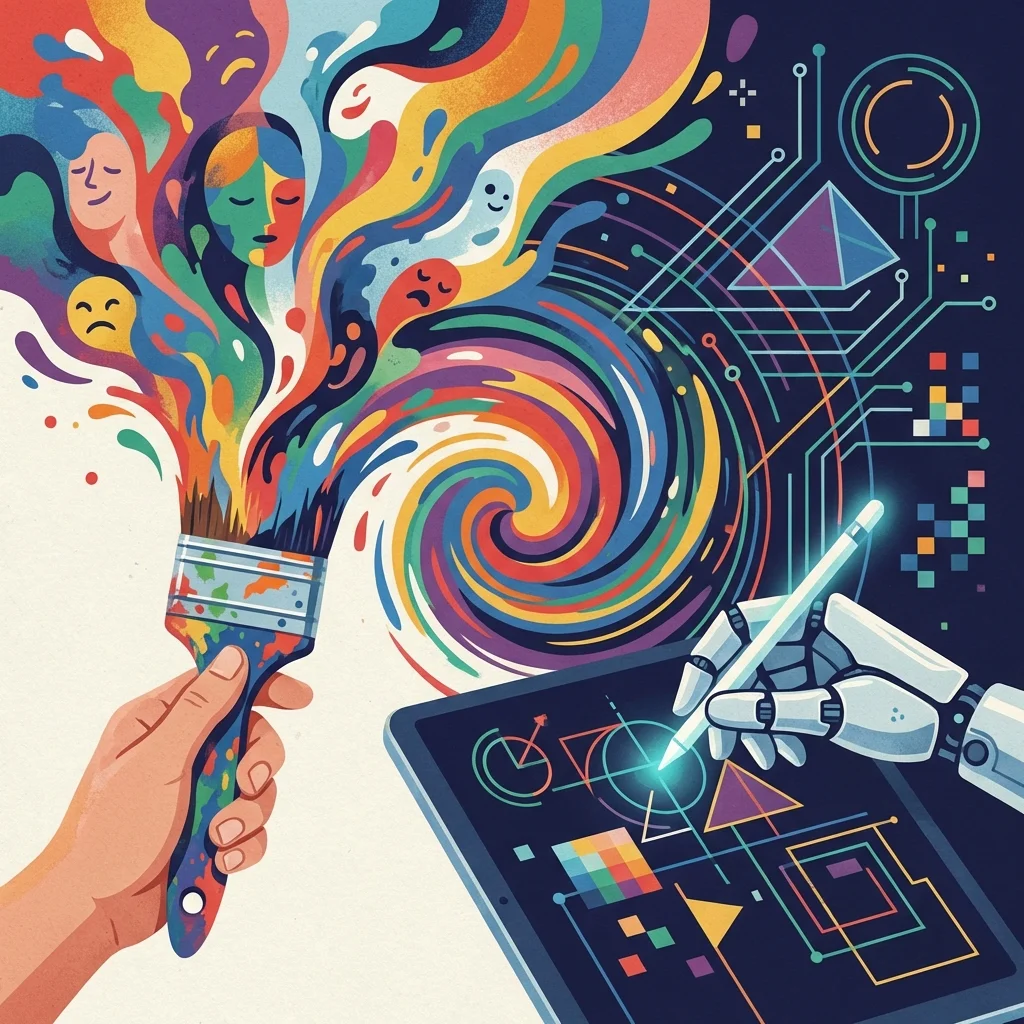
(source by gemini AI)
The world of art is facing its most significant disruption since the invention of photography in the 19th century. Tools like Midjourney, DALL-E 3, and Sora have evolved from producing glitchy, abstract nightmares into generating breathtaking oil paintings, hyper-realistic photography, and cinematic videos in a matter of seconds.
This technological leap has triggered an existential crisis within the global creative community. Is this the ultimate democratization of creativity—allowing anyone to visualize their dreams—or does it constitute the greatest intellectual property theft in history?
The question occupying every artist’s mind is no longer “Can AI make art?” but rather a much deeper philosophical inquiry: “Does art require a human soul to be valuable?”
This article explores the harsh realities, the valid fears, and the undeniable shift in what it means to be an artist in the age of algorithms.
1. The Anatomy of the Machine: How “Smart” is AI Art?
To truly understand the threat, we must first demystify the mechanics. When you type a prompt like “A cyberpunk cat in the style of Van Gogh” into an AI generator, the machine is not “imagining” a cat in the way a human does.
The Stochastic Parrot
AI models function as massive probabilistic engines. They have been trained by analyzing billions of image-text pairs scraped from the open internet. Through this training, they learn statistical correlations: they know that the word “Van Gogh” correlates with swirling brushstrokes, thick impasto textures, and a specific yellow-blue color palette. They know “cyberpunk” correlates with neon pinks, rain-slicked streets, and mechanical augmentation.
- The Critical Difference: A human artist paints a cat based on their lived memory of a pet they loved, their study of feline anatomy, and their current emotional state. AI generates a cat by mathematically averaging millions of cat pixels it has seen before. It is mimicry at scale, not conscious creation.
The “Uncanny Valley” Problem
Despite its power, AI still struggles with the nuances of reality. This is most visible in the “Uncanny Valley”—where an image looks almost human but slightly wrong, causing a feeling of unease.
- Why hands are hard: You’ve likely seen AI generate people with 6 fingers. This happens because AI doesn’t understand the concept of a hand (palm + 5 fingers). It only sees “flesh-colored shapes” that usually appear at the end of arms. Without a biological understanding of anatomy, it treats fingers as just texture patterns, often repeating them unnecessarily.
2. The Great Ethical Divide: Inspiration vs. Industrial Theft
The controversy tearing the art world apart isn’t about the quality of the output; it’s about consent and compensation.
Proprietary AI models were trained by scraping the portfolios of living, working artists from platforms like ArtStation, DeviantArt, and Pinterest without permission, credit, or payment.
- The “Glaze” & “Nightshade” Resistance: In response, researchers at the University of Chicago developed tools like Glaze and Nightshade. These tools mathematically “poison” digital images before artists upload them. To a human eye, the image looks normal, but to an AI model attempting to learn the style, it looks like chaotic noise. This is the first line of defense in the “style wars.”
- The Legal Battlefield: High-profile lawsuits (e.g., Sarah Andersen vs. Stability AI) are currently testing fair use laws. The core legal question is: Is training an AI on copyrighted work “transformative” enough to be legal? The outcome of these cases will define the future of intellectual property.
Economic Impact: A 2024 report on the gig economy showed a 40% drop in freelance illustration jobs on platforms like Upwork and Fiverr, as clients opt for instant, cheap AI generation over hiring junior concept artists.
3. Copyright Crisis: Can a Machine Own Art?
If an AI generates a masterpiece, who owns it? The user who typed the prompt? The company that built the AI? Or no one?
The “Monkey Selfie” Precedent
Legal experts often point to the famous Naruto vs. Slater case (the “Monkey Selfie” case). In 2011, a macaque monkey took a selfie with a photographer’s camera. The US Copyright Office ruled that copyright can only be held by a human being. Non-humans (animals, and by extension, machines) cannot own copyright.
Currently, the US Copyright Office adheres to this. Purely AI-generated art has no copyright protection. It is technically in the public domain. This makes it risky for major movie studios or game companies to use raw AI assets, as they cannot legally stop others from stealing them.
4. The Shift: From Creator to Curator
Just as photography shifted art from “capturing reality” (the job of portrait painters) to “interpreting reality,” AI is shifting the artist’s role from Creator (making every brushstroke) to Curator (directing the vision).
We are witnessing the rise of the “Synthographer” (Synthetic Photographer) or AI Artist. Their primary skill is not hand-eye coordination, but:
- Prompt Engineering: The ability to translate abstract, vague ideas into precise, descriptive linguistic instructions that guide the model.
- Iterative Curation: Generating 100 variations, having the refined taste to select the single one that works, and then fixing its flaws.
The Hybrid Future: The most successful artists of tomorrow likely won’t be “Pure AI” or “Pure Analog.” They will be Centaurs—humans who use AI to accelerate their workflow (generating mood boards, textures, or rough composition sketches) but apply their unique human taste and manual skills to finalize the work.
5. What AI Can’t Replace: The “Aura” and The Story
If AI can eventually create technically perfect images that are indistinguishable from human work, what is left for humans? The answer lies in Context and Story.
Philosopher Walter Benjamin spoke of the “Aura” of a work of art—its presence in time and space, its history.
- The Story Value: We value a Frida Kahlo painting not just because the colors are nice, but because we know her story of physical pain, love, and resilience. The biography of the artist is inseparable from the art.
- The Intent: When a human makes a jagged line, it’s an emotional choice. When AI makes a jagged line, it might just be a rendering error.
AI can simulate the texture of sorrow, but it has never felt grief. It can generate a love letter, but it has never been in love. In a world flooded with instant, perfect, synthetic content, human imperfection, struggle, and authentic backstory will become the ultimate luxury goods.
Conclusion: The Tool vs. The Master
History is repeating itself. In the 19th century, painters panicked that photography would destroy art. “Why paint a landscape if a camera can capture it perfectly in a second?” they asked.
But photography didn’t kill painting. Instead, it freed painting from the burden of realism. Because cameras could capture reality, painters were forced to invent Impressionism, Cubism, and Abstract Art—styles that captured feelings rather than just facts.
AI will likely do the same. It will kill “mediocre commercial art” (generic stock photos, basic logos), but it will force human artists to dig deeper, to be more personal, more radical, and more human than ever before.
“Art is not what you see, but what you make others see.” - Edgar Degas
Author
Author