AI and the Future of Work: Which Jobs Will Survive the Revolution?
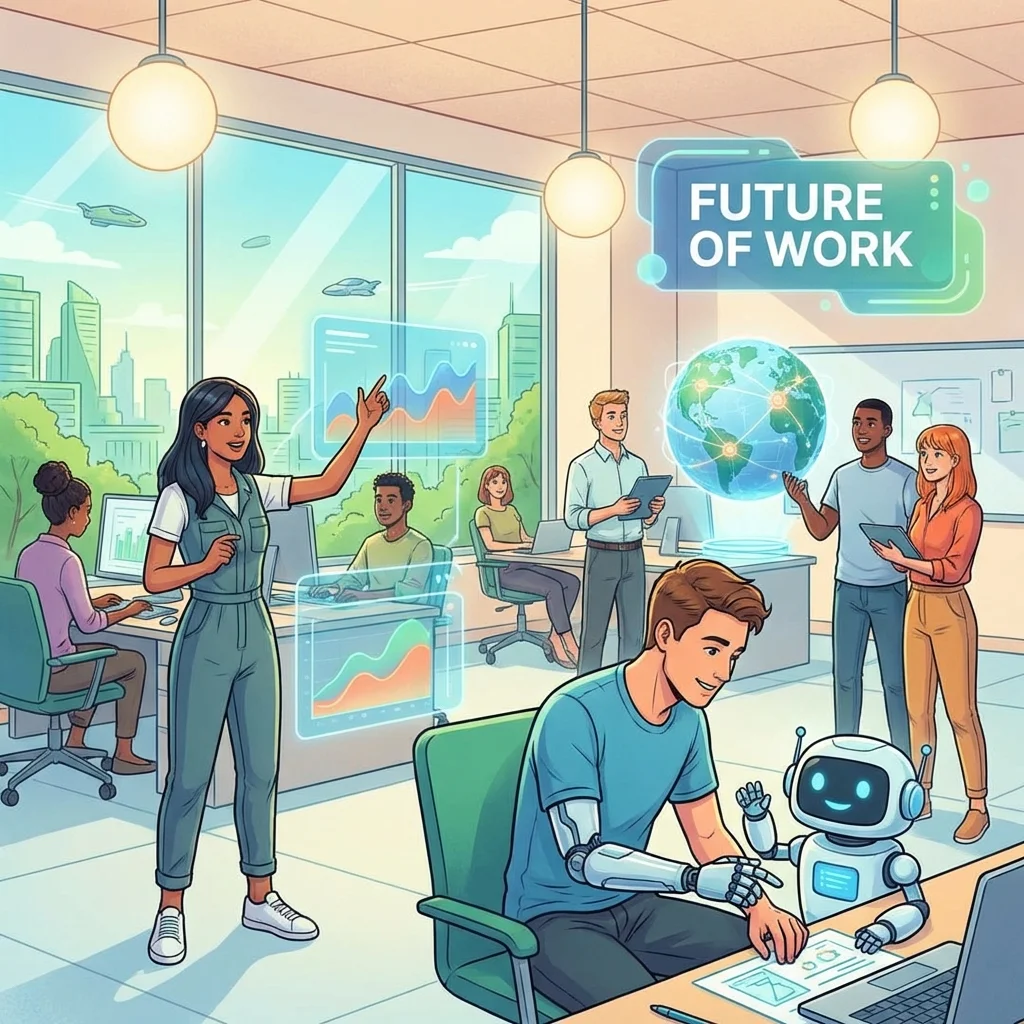
Every time a new technology emerges, one question dominates the conversation: “Will I lose my job?” We’ve seen this pattern before—when machines entered factories, when computers arrived in offices, when the internet disrupted entire industries. Now, it’s AI’s turn.
The media loves dramatic headlines: “AI Will Replace Millions of Jobs,” “Robots Are Taking Over,” and similar fear-mongering narratives. It’s no wonder anxiety is high, especially for those working with data, content, or knowledge work.
But the reality is far more nuanced than the headlines suggest.
This article examines the intersection of AI and the future of employment—which professions are genuinely at risk, which are likely to thrive, and most importantly: what you can do to remain relevant in an AI-augmented workforce.
1. Understanding the Pattern: This Isn’t the First Disruption
Before we panic, let’s examine historical precedent. Technological disruption is not new:
- The Steam Engine (1800s) eliminated countless manual labor jobs in agriculture and traditional craftsmanship but created factory jobs, engineering roles, railroad workers, and an entire industrial economy that employed far more people than before.
- Computers (1970s-1990s) reduced clerical work and made typewriter repairmen obsolete but spawned entirely new professions: programmers, IT specialists, database administrators, UX designers, and digital marketers.
- The Internet (1990s-2000s) shuttered many brick-and-mortar businesses and killed the travel agent profession but opened massive opportunities in e-commerce, digital marketing, app development, and the gig economy.
AI is the continuation of this pattern. What changes isn’t just the types of jobs, but how we work.
The critical difference this time? Speed. Previous technological shifts took 30-50 years to fully materialize. AI is evolving exponentially. GPT-3 to GPT-4 took 18 months. The pace of change is unprecedented.
2. Why Does AI Feel More Threatening?
Previous automation waves primarily targeted physical labor. Robots replaced assembly line workers. Tractors replaced farm hands. But these changes were visible, predictable, and society had time to adapt.
Now, AI is encroaching on cognitive labor—writing, analysis, design, diagnosis, and preliminary decision-making. For the first time, “knowledge workers” (those who were told “get a degree and you’ll be safe”) are feeling existential dread.
The psychological impact is profound because these were the jobs middle-class society deemed “future-proof.” The implicit social contract was: “Blue-collar jobs will be automated, but if you learn to code / become a lawyer / work in finance, you’re safe.” That contract is being rewritten.
The Moravec’s Paradox
Interestingly, AI exhibits what’s called Moravec’s Paradox: tasks that are hard for humans (complex calculations, pattern recognition in massive datasets, playing chess) are trivially easy for AI, while tasks that are easy for humans (folding laundry, navigating a chaotic environment, understanding sarcasm, reading a room) remain extremely difficult for machines.
This is why a robot can beat the world chess champion but struggles to make a simple cup of coffee in an unfamiliar kitchen. It’s why AI can write a grammatically perfect essay but fails to understand why a joke is funny.
Implication: Jobs requiring physical dexterity in unpredictable environments and high emotional intelligence remain surprisingly safe.
3. The Core Principle: AI Replaces Tasks, Not Entire Professions
This is the single most important distinction, backed by research from MIT economist David Autor. AI rarely eliminates an entire profession wholesale. Instead, it automates specific tasks within that profession.
Tasks Most Vulnerable to AI:
- Repetitive processes (data entry, invoice processing, basic photo editing)
- Pattern-based work (initial legal document review, preliminary medical scan analysis)
- Predictable workflows (scheduling, inventory management, standard email responses)
A single profession typically comprises dozens of tasks. As long as some portion requires empathy, creativity, accountability, ethical judgment, or handling novel situations, humans remain essential.
Example: A radiologist’s job includes analyzing scans (which AI can assist with at 95%+ accuracy), but also consulting with anxious patients, explaining diagnoses in layman’s terms, collaborating with surgeons on treatment plans, and making nuanced judgment calls in ambiguous cases where even the data is unclear. AI handles the first part brilliantly; humans remain critical for everything else.
This leads to job augmentation rather than replacement. The radiologist doesn’t disappear—they become more efficient, handling more patients with better diagnostic support.
4. High-Risk Professions: Not Eliminated, But Drastically Reduced
These jobs won’t disappear overnight, but demand will shrink by 40-70% over the next decade:
A. Administrative and Data Entry Roles
AI excels at structured data processing. Tasks like transcription (Otter.ai, Whisper), form filling, and basic bookkeeping are already being automated at enterprise scale. Impact: A company that needed 10 admin assistants may now need 3.
B. Entry-Level Customer Service
For FAQ inquiries, order status checks, and routine support tickets, AI chatbots (like Intercom’s Fin) resolve 50-70% of requests without human intervention. Human agents now handle complex, emotionally sensitive cases that require genuine empathy and creative problem-solving.
C. Generic Content Writing
AI can generate product descriptions, basic SEO articles, and formulaic content at massive scale. The $5/article content mill writer is effectively extinct. However, investigative journalists, thought leaders, and writers with unique voices remain in high demand because readers crave authentic human perspective.
Data Point: A 2024 McKinsey report estimated that 30% of tasks currently performed by the US workforce could be automated by 2030, affecting up to 12 million workers who will need to transition to new roles or upgrade their skills.
D. Junior-Level Creative and Analytical Work
Template-based design (basic social media graphics, standard logos) and junior analyst tasks (pulling reports, creating basic charts) can now be done instantly by AI. This creates a hollowing out effect—senior roles remain, but the traditional “learning ladder” disappears.
The Problem: If there are no junior roles, how do people gain experience to become seniors? This is a genuine concern that industries must address through new apprenticeship models.
5. Professions Likely to Thrive (and Even Expand)
A. High-Empathy Roles
Psychologists, therapists, social workers, elder care workers, teachers (especially early childhood), and hospice nurses. AI cannot replicate genuine human connection, trust-building, or the subtle art of reading micro-expressions and emotional undertones.
Insight: As society becomes more isolated (ironically accelerated by technology), demand for human connection professionals is actually increasing. Mental health services saw a 40% surge post-pandemic.
B. Creative Professions with Strong Personal Identity
Opinion writers, investigative journalists, fine artists, filmmakers with distinct voices, musicians, and stand-up comedians. AI can mimic technique, but it cannot be you. In a world flooded with synthetic content, authentic human storytelling with a personal backstory becomes a premium commodity.
Why? Because we value art not just for what it looks like, but for who made it and why. We care that a song was written by someone who experienced heartbreak, not a statistical model.
C. Strategic and Leadership Roles
CEOs, consultants, project managers, military strategists, and entrepreneurs. AI provides data, forecasts, and scenario analysis; humans make final decisions, especially in ambiguous, high-stakes scenarios involving ethics, cultural nuance, and long-term vision.
Example: AI can analyze market data and suggest “this product will sell,” but a CEO must decide “Should we sell this product?” considering brand values, long-term reputation, and societal impact.
D. AI-Adjacent Technical Roles
Prompt engineers, AI trainers (teaching models to avoid bias), machine learning ethics consultants, AI auditors, and data scientists. The people who understand, manage, and regulate AI will be in explosive demand. LinkedIn reported a 400% increase in “AI prompt engineer” job postings in 2024.
E. Skilled Trades and Physical Work
Electricians, plumbers, HVAC technicians, mechanics, construction workers, and hairstylists. General-purpose robots remain prohibitively expensive and inflexible for most physical tasks. A robot can assemble a car in a controlled factory, but it can’t fix a leaky pipe in a 100-year-old house with no blueprints or cut your hair based on a vague description of “just a little shorter.”
Economic Reality: You can’t offshore a plumber. And until Boston Dynamics robots become cheaper than human labor (decades away), these jobs are secure.
6. The Skills That Make You “AI-Proof”
Rather than obsessing over job titles, focus on cultivating transferable, human-centric skills:
1. Critical Thinking & Verification
The ability to evaluate whether AI-generated output is accurate, logical, biased, and contextually appropriate. In a world where AI hallucinates confidently, humans who can fact-check and sanity-test are invaluable.
2. Complex Problem-Solving
Tackling messy, real-world problems that don’t have clean datasets, obvious solutions, or historical precedent. AI excels in structured environments; humans excel in chaos.
3. Emotional Intelligence (EQ)
Building relationships, negotiating win-win scenarios, reading a room, defusing tense situations, and navigating organizational politics—areas where AI is fundamentally limited. High EQ is the new IQ.
4. Technological Adaptability
Not being afraid to learn new tools. The best protection against AI isn’t avoiding it—it’s knowing how to use AI as a 10x leverage tool. The accountant who learns AI-powered analytics tools thrives; the one who refuses falls behind.
5. Contextual Creativity
Generating ideas that are specific to a unique situation, culture, audience, or moment in time—something AI’s training data can’t easily replicate. Local knowledge and cultural fluency become competitive advantages.
7. The Real Threat: Not Learning to Use AI
The workers most at risk aren’t those whose jobs can be assisted by AI, but those who refuse to adapt. History is littered with examples:
- Kodak engineers invented the digital camera in 1975 but refused to embrace it, fearing it would cannibalize film sales. Kodak went bankrupt in 2012.
- Blockbuster was offered the chance to buy Netflix for $50 million in 2000 and laughed it off. Blockbuster closed in 2013.
Research consistently shows that human + AI outperforms AI alone or human alone in most domains.
Case Study: In legal research, AI tools like ROSS Intelligence and LexisNexis Practical Guidance can scan thousands of cases in seconds. Lawyers who embraced these tools can now serve 3x more clients with better research quality and lower billable hours. Those who refused are being undercut by tech-savvy competitors.
8. Career Transition Strategies: What Should You Actually Do?
If you’re in a high-risk profession, here’s a practical roadmap:
Step 1: Audit Your Tasks
List everything you do in a typical week. Identify which tasks are repetitive/predictable (likely to be automated) vs. creative/interpersonal (likely to remain human).
Step 2: Double Down on the Human Tasks
Shift your focus toward the parts of your job that require uniquely human skills. If you’re a customer service rep, specialize in conflict resolution and emotionally complex cases rather than order tracking.
Step 3: Learn to Manage AI
Take courses on prompt engineering, AI ethics, or tools relevant to your field. Becoming the “AI specialist” in your department makes you indispensable.
Step 4: Build a Personal Brand
In a world of AI-generated content, a strong personal voice, reputation, or network becomes your moat. Clients hire “you,” not a commodity service.
Conclusion: Adaptability Beats Job Title
The question “Will AI replace my job?” is the wrong framing. The better question is: “How can I use AI to become 10x more valuable?”
The professions that will thrive aren’t defined by their names but by the mindset of the people in them:
- Curiosity over complacency
- Collaboration with AI, not competition
- Continuous learning, not resting on credentials
AI is changing how we work—and change is always uncomfortable. But history shows that humanity always finds new ways to remain relevant and create value. As long as you’re willing to learn, adapt, and use AI wisely, the future of work isn’t something to fear. It’s an opportunity to work smarter, more humanely, and more meaningfully.
Author
Author